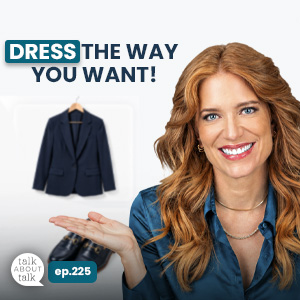
How to dress at work, your personal style, and personal branding all come together every morning when you’re standing in front of your closet, considering what to wear.
Executive communication coach Andrea C. Wojnicki is updating her own advice. She used to say “Dress to reinforce your personal brand.” Her new advice? “Dress the way you want, with purpose.”
You’ll learn why “dress for the job you want” falls short, how Dolly Parton’s “do it on purpose” philosophy connects to personal branding, and how one sentence can turn your hoodie, your bold colors, or your signature piece into a statement of your values. Plus, the research on what your clothes signal to others and to yourself, and three dress code rules that are still true.
Enjoy more insights and ideas from Andrea! Subscribe to Andrea’s Substack for her latest articles and updates: https://andreawojnicki.substack.com/subscribe
CONNECT WITH ANDREA
🌐 Website: https://talkabouttalk.com/
🔗 LinkedIn: https://www.linkedin.com/in/andreawojnicki/
🟠 Andrea’s Substack: https://andreawojnicki.substack.com/subscribe
✉️ Andrea’s Email Newsletter: https://www.talkabouttalk.com/newsletter/
🟣 Talk About Talk on Apple Podcasts: https://podcasts.apple.com/us/podcast/talk-about-talk-communication-skills-training/id1447267503
🟢 Talk About Talk on Spotify: https://open.spotify.com/show/3afgjXuYZPmNAfIrbn8zXn?si=9ebfc87768524369
📺 Talk About Talk on YouTube: https://www.youtube.com/@talkabouttalkyoutube
RESOURCES MENTIONED
Andrea C. Wojnicki: Recently, I took my daughter to a Harry Styles concert in New York. Let me start by saying that I was both shocked and thrilled when Harry stepped out on stage. As always, he exuded fantastic, positive energy. I love how he enthusiastically dances around on stage, and he always has this friendly smirk on his face.
Anyway, why was I shocked and thrilled? Well, it’s because he was wearing a bright turquoise shirt and wide white pants. And guess what? So was I. I felt so validated, and yes, perfectly on brand. I was with my 18-year-old daughter, and she was wearing my tall black boots, a denim miniskirt that her college roommate had lent her, and her own sequined miniskirt as a top.
Yes, you heard me right. She was wearing her miniskirt as a top. And you know what? It worked. She looked fantastic, so I told her so. And I remember she looked at me a little surprised, and she said, “Really? I thought you’d get mad.” Hmm, that really stuck with me. Anyway, the very next day, I read a piece in The New York Times questioning how Gen Z is dressing these days.
The gist of the article was that Gen Z dresses like they don’t know how to dress. Again, hmm. My reaction: who says they don’t know how to dress? They’re breaking the rules, and they’re dressing the way they want to dress. Based on this experience, conversations I’ve had with audiences in various Q&As, plus my reading about Dolly Parton. Yes, Dolly Parton, I am officially updating my own advice about personal style and how we should show up at work.
If you have ever stood in front of your closet on a work morning wondering what you should wear and what it says about you, this episode is for you. Let’s do this. Let’s do this. Let’s talk about talk.
Welcome to the Talk About Talk podcast. My name is Dr. Andrea Wojnicki. Please just call me Andrea. I’m an executive communication coach here at Talk About Talk, where I coach ambitious leaders and aspiring leaders to communicate with confidence and credibility so they can achieve their career goals.
You can learn everything you need to know about me and about Talk About Talk if you go to talkabouttalk.com. Yes, I made it easy for you. Talkabouttalk.com. You’ll find information there on my keynote speaking, corporate workshops, online courses, and lots more, including free resources. While you’re there, I encourage you to sign up for my free email newsletter.
That’s just like getting more free coaching from me.
If you’ve been listening to the Talk About Talk podcast for a while, you probably know that I am a big fan of the power of three. So we are going to cover three things today. First, I’m gonna tell you how and why I changed my mind, and what I now recommend we do instead in terms of our personal brand.
Spoiler alert, my personal style mantra is completely aligned with my definition of personal branding. Second, I’m gonna coach you on why you should say it out loud. That is, put words around how you show up and why. And third and last, a short still true session. These are three factors from my earlier advice that I still believe in because they help you show up with purpose, on purpose.
Sound good? Okay. Before we dive in, a quick and necessary disclaimer. It’s this: I am not a stylist. I am not gonna tell you which brand of shirt to wear with which pants or exactly how to style it. What I am gonna share with you are some factors to consider when you’re shopping, or perhaps more importantly, when you’re staring at your closet deciding what to wear.
Because what you wear signals or communicates so many things. I’ll also share some of what the research says about all this. It’s fascinating. The last time I did an episode on how to dress for work was episode number 122. If you go back and listen to that episode, you’ll hear the old advice. Today, you get the update.
Dress the Way You Want, with Purpose
Okay, let’s get into this. First, how and why I changed my mind about my advice when it comes to personal style. Let’s start with what I used to say. For years, my coaching advice on this whole topic was simple: show up in a way that reinforces your personal brand. Sounds reasonable, right? If you and I have worked together on your personal brand, you know exactly what that means.
Together, we’ve built your personal brand template. We’ve identified and listed your 10 to 15 personal brand themes, your strengths, your passions, your credentials, and we’ve articulated your superpowers. My advice was to take that output and then dress in a way that reinforces this brand. If we haven’t worked together, this advice still makes sense.
It still stands. Think about your positive and unique strengths. Think about the value that you offer in the marketplace in terms of your professional identity. And of course, consider your aspirations. Then ask yourself, “How can I dress in a way that reinforces all of this?” It’s really not bad advice. But I must tell you, based on a variety of experiences, inputs, learnings, I’ve changed my coaching suggestion here.
Here’s what I say now. Dress the way you want to dress, and do it with purpose Let me say that again. Dress the way you want with purpose. So what’s changed my mind? Let me tell you about Dolly Parton. One of the things that I preach to my clients is that unique is better than better, and I’ve rarely seen anyone personify this quite like Dolly Parton.
She died this past August at the age of 80. She had big hair. She had the sparkles. She had the long nails. And many people would not have expected someone with that, what we’ll call ultra-feminine aesthetic, to become as successful an entrepreneur and businesswoman as she did. Think about it. She built a successful business empire.
She built her own theme park, Dollywood, right? She created the Imagination Library, where she gave books away for free to children to improve literacy. And yes, she was criticized for her look, and she talked about this openly. In one interview that I read about, she described how people early in her career pushed her to simplify her hair and the way she dressed.
Their warning, as she put it, was, “No one is gonna take you seriously.” Her response? She doubled down. She famously joked, “It costs me a lot of money to look this cheap.” As far as I could tell, her attitude was, “You do you. I love this. You do you.” Some people might have assumed that her appearance just didn’t fit with being a serious businesswoman.
She showed them both parts of who she was, or perhaps I should say she showed them all of who she was. Dolly made me think twice about how we show up, and here’s the part that gives me the goosebumps now. One of Dolly’s most famous pieces of advice was this: “Find out who you are and do it on purpose.” She shared this with graduates at the University of Tennessee back in 2009, and then more recently in an interview with Today, she added a second line: “Do it with purpose.”
Why does this give me the goosebumps? Well, because if you’ve listened to this podcast before, you know that my definition of personal branding is personal branding is being yourself on purpose. The be yourself part is about authenticity. It’s about being your whole, true, and yes, best self. The on purpose part is about intentionality.
It’s about taking a few minutes to think about the words you use, how you talk about yourself, what you say in meetings, and yes, how you show up in terms of your personal style. So my new advice is dress the way you want with purpose. This is not a departure from my definition of personal branding. In fact, it’s perfectly aligned with it.
This is what being yourself on purpose looks like. Now, before you run off and wear your sequined skirt as a top at the next board meeting, let me be very clear about something. I am not saying that what you wear doesn’t matter. It does. We are all sending signals all the time. People make assumptions based on how you show up.
We’ll get into the research on this in a few minutes, but here’s my shift. Instead of starting with what will other people think, start with who am I and what do I want to communicate? Then make your choices about how you show up, about your personal style on purpose. This brings me to an old adage that I still hear all the time: Dress for the job you want, not the job you have.
How to Dress Authentically in Different Work Environments
I’m sure you’ve heard this. Now, certainly, if you’re going into a job interview, you need to understand the expectations. What is the culture of this industry and this organization? How are people dressing? How formal is it? This is all just smart preparation. Let me tell you a little bit about my husband.
Okay, I’m talking a lot about my family here in this episode, aren’t I? Okay. Anyway, my husband is a business consultant, and his industry focus is metals and mining. I would say that he does not give a lot of thought and attention to his personal brand. I have never coached him on the personal brand development process.
But I do know that he thinks about how he shows up, especially the contrast between what he wears when he goes downtown to meet with the CEO and senior leaders of one of his clients versus what he wears when he goes out to a mining site. Here’s the thing: he is being authentic in both cases. He’s dressing the way that he wants.
He’s thinking about how he wants to show up, but he’s doing it with purpose. Downtown, he’s signaling that he belongs in the room with senior leaders. At the mining site, he’s signaling that he’s there to do the work, and he respects the people and the conditions on the ground. Same person, different contexts, different outfits, all of it on purpose.
So I encourage you to do the same. Before you get dressed, ask yourself a couple of quick questions. Who am I gonna see today? What do I need to get done? How do I wanna feel? And maybe even, how do I wanna be remembered? Your answers to these questions will shape what you wear. This is what I mean by showing up on purpose.
You’re still the one choosing, and you’re still being you. So that’s my updated take on the old adage, “Dress for the job you want.” Sure. Dress to reinforce your personal brand. Sure. But more importantly, dress for yourself with intention. Dress the way you want with purpose. Got it? Okay. So now we’ve covered the first big idea.
Say It Out Loud: Let Your Personal Style Tell Your Story
Dress the way you want with purpose. Now for the second big idea, and this one might not surprise you. It’s this. Say it out loud. This is what I call controlling your narrative, which is a significant theme in my workshops and my coaching, and even in my forthcoming book called Let Me Introduce Myself.
Controlling your narrative can be a game changer, even when you’re controlling the narrative around your personal style and why you dress the way you dress. Let me tell you a story. A few months ago, I was teaching a two-and-a-half-hour virtual workshop sitting right here where I am right now, and the workshop was on developing your personal brand.
Towards the end of the workshop, we got into this topic of style and how you show up at work, and one of the more vocal, and I’ll say impressive, participants in the group raised his hand, and he shared with us that he was working from home today, and he’s wearing a hoodie. But he also told us that this is how he shows up when he goes into the office.
He wears a hoodie and sweatpants most of the time. He explained to us that he does his best work when he feels comfortable. So I started asking him a few more questions, and he revealed that he aspires to become the CEO someday. Now the old me might have said something about dressing for the job you want, but that’s not what I said.
Instead, I complimented him. I told him that it sounded like he was already dressing the way he likes and with purpose, and then I gave him this suggestion: take the explanation that you just shared with us and share it more broadly. Share it explicitly. Tell people that you purposefully dress comfortably because that’s how you do your best work.
Tell them that you encourage your team to do the same, and tell them that someday when you’re the CEO, you’re gonna make this part of the corporate culture. After I finished my speech to him, he admitted that he’d never thought of doing that, and he said that he would definitely start talking about why he dresses the way he dresses.
And here’s why this matters. When you put words around how you show up, a few powerful things can happen. In this case, he’s no longer just the guy in the hoodie and whatever stereotypes we may have of the guy in the hoodie. He’s talking about what he needs to do his best work, to be productive and to produce the best quality work.
He’s showing that he cares about his team doing their best work, too. And he’s sharing his aspiration to be CEO. Suddenly, the hoodie isn’t a question mark. It’s a visual, tangible statement of his values. Drop the mic, right? When you say it out loud, your style stops being a question mark and becomes a statement.
I’m thinking about a woman I know who purposely dresses in bold colors. She tells people that her clothing matches her personality, which is big, as opposed to her stature, which is tiny. I love how she dresses for her personality, and I love even more the fact that she calls it out explicitly. People remember it, and they remember her.
So for me personally, it’s the color turquoise. I love turquoise. It makes me happy. It’s a vibrant, energetic color, and people often tell me that they appreciate my energy, so it’s aligned. And some of my colleagues have even commented on it. It literally happened yesterday. They haven’t seen me for a while, and I’m not wearing turquoise, and they ask me if I’m okay.
It’s because turquoise and my energy are part of what people remember about me. So what is it for you? Maybe it’s a signature color, or it could be a classic piece that you wear often, like Steve Jobs and his black turtleneck. Maybe it’s flashy neckties or gorgeous shoes or silk scarves or funky eyeglasses.
You get the idea. So here’s your exercise. Write one sentence that starts with, “I wear”, and includes the word because. For example, “I wear bold colors ’cause they match my personality,” or, “I dress comfortably because that’s how I do my best quality work.” And then the next time someone comments on your style, or maybe the next time you’re introducing yourself to a new team, say it out loud.
What Your Clothes Communicate: Three Rules That Still Matter
Got it? Okay. Moving on to my third piece of advice, our third focus area here. As I said, I’ve changed my mind on a lot of things here when it comes to personal style, and since I first recorded an episode on this topic years ago with episode 122. But some of what I shared back then is still true, and these insights can help you dress with purpose.
First, a quick reminder of why this matters at all. The research is crystal clear that what you wear sends signals actually in two directions, both outward to other people and inward to yourself. And let’s be clear, both matter. In a classic 1991 studies, researchers showed students and teachers photos of models in different clothing styles.
The more formally dressed models were rated as more intelligent. Scary, right? We’re judging intelligence from your clothing? I know what you’re thinking. That was decades ago, and now casual clothes are the norm, Andrea. I get you. I wore high-heeled loafers when I was on stage yesterday, and I regretted not wearing my bright turquoise sneakers.
I probably would have felt better and maybe even looked better. At least it would’ve been more noticeable and memorable and maybe more contemporary. So I’m not here to tell you that you need to dress up, but again, you do need to dress with intentionality and think about how others perceive you. There’s more research that concludes that employees feel more authoritative, trustworthy, and competent in formal business attire, but they feel friendliest in casual or even business casual attire.
So casual isn’t wrong. It just signals something different. There’s another study published in 2014 where men negotiated a mock sale of a factory, and some of these men wore business suits, and some wore sweatpants. The men in suits earned more profit and made fewer concessions in their negotiations, and their counterparts felt less powerful negotiating against them.
In another study, participants all wore the same white lab coat. For some, it was described as a doctor’s coat, and for others, it was described as a painter’s coat. You can guess the results. The folks in doctor’s coats performed better on various tasks. Same coat, different meaning, different feeling, different performance.
So the point here is that what you wear matters. You are signaling things to yourself and to others, and this has implications. This is why you need to dress the way you want, but yes, with purpose. Here are three factors that are still true. Number one, formality. If you’re not sure, dress up, not down, especially in a context where competence, trustworthiness, and authority are things that you wanna be known for.
And here’s a tip. You may or may not have heard this before. Be prepared for the unexpected. Keep a basic blazer on a hanger on the back of your door or on the back of your chair or in your car for that surprise event where you need to step it up. Number two, my second suggestion is this: hair, hands, and feet. This is an adage that I learned from a friend of mine who modeled in her teen years, and her suggestion is this: when we pull together an outfit, we typically think top and bottom, right?
Shirt and pants. But if you really wanna look pulled together, pay attention to your hair, your hands, and your feet. That means your hair is cared for, your hands are presentable, including your nails and maybe jewelry, and your shoes are clean and polished. It doesn’t mean that they need to be dressy, but they do need to be clean.
So that’s the second point, hair, hands, and feet. Number three, my third suggestion: know the code. There’s the dress code for an event. There’s your firm’s perhaps written out and perhaps not dress code, and there’s the seasonal dress code, too. Summer is when it’s easier to slip into something casual, maybe even too casual.
If you don’t know what a dress code is, ask the organizer. Look around at the successful senior people in your organization. Then, within that code, dress the way you want with purpose. Remember my daughter at that Harry Styles concert? She knew exactly the code for a Harry Styles concert. She just played with it, and that’s what I’m encouraging you to do, too.
Three Takeaways for Dressing with Confidence and Purpose
Okay, let’s wrap this up. As promised, and as I always do, here’s a quick summary. Three things I want you to remember. One, it’s as simple as this: dress the way you want with purpose. Two, say it out loud. Put words around how you show up and why. When you do, your style stops being a question mark and becomes a statement of your values, your strengths, and your aspirations.
And third, while pop culture and the way we dress certainly is evolving, some things are still true. If you’re not sure, dress up, not down. Remember hair, hands, and feet, and know the code, so you can choose how to play within it. The next time you’re standing in front of your closet feeling uninspired or confused, I hope you remember this: You get to decide.
Just do it with purpose. Okay, now, I do have an ask. If this episode provided you with some useful insight, please share it with someone who could use it. It might be a colleague, a friend, or maybe someone in your life who is wondering whether they’re dressing right at work. Yes, I’m asking you to talk about Talk About Talk.
And if you haven’t left a rating or a review for us yet, now would be a perfect time to do so. Whether you’re watching on YouTube or listening on Apple, Spotify, or whatever podcast platform you’re on, look at the screen. It’ll only take you about 60 seconds. It costs you nothing, and it makes an enormous difference in helping new listeners find the show.
Thank you so much for listening, and talk soon.