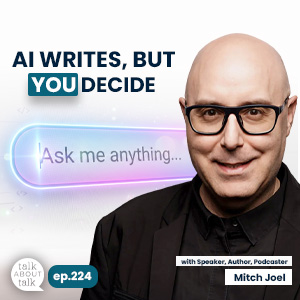
Worried AI is making everyone sound the same, or that it will replace the value you bring to work? Mitch Joel, author, speaker, and executive director of The Next Era Institute, shares how to build a personal brand people want to follow, why “does it land?” matters more than “is it AI?”, and how to use AI as a superpower instead of an answer engine. You’ll also learn where your value lives when AI takes over the tasks you hate, and why your network is your net worth.
CONNECT WITH ANDREA
🌐 Website: https://talkabouttalk.com/
🔗 LinkedIn: https://www.linkedin.com/in/andreawojnicki/
✉️ Andrea’s Email Newsletter: https://www.talkabouttalk.com/newsletter/
🟣 Talk About Talk on Apple Podcasts: https://podcasts.apple.com/us/podcast/talk-about-talk-communication-skills-training/id1447267503
🟢 Talk About Talk on Spotify: https://open.spotify.com/show/3afgjXuYZPmNAfIrbn8zXn?si=9ebfc87768524369
📺 Talk About Talk on YouTube: https://www.youtube.com/@talkabouttalkyoutube
CONNECT WITH MITCH JOEL
🌐 Website: https://www.mitchjoel.com/
🔗 LinkedIn: https://www.linkedin.com/in/mitchjoel/
🎙️ Thinking With Mitch Joel Podcast: https://www.sixpixels.com/category/podcast/
📝 Welcome To Vibe Content: https://www.sixpixels.com/articles/archives/welcome-to-vibe-content/
🏢 Platform: https://www.thinkersone.com/
BOOKS AND RESOURCES MENTIONED
Mitch Joel: I think ultimately a personal brand is a collective sentiment about how an audience feels about you, and the only way you’re gonna develop that or push that forward is by having something unique in the sense of something they wanna be connected to.
Andrea C. Wojnicki: That was Mitch Joel, author, speaker, podcaster, and yes, thought leader.
AI, Personal Branding, and the Future of Thought Leadership
In this episode of the Talk About Talk podcast, you’re gonna hear my conversation with Mitch Joel, where we focus on AI, personal branding, and thought leadership. Three big topics. So fasten your seat belts because Mitch shares some ideas and perspectives that I promise will challenge you and inspire you.
Let’s do this. Let’s talk about Talk. Welcome to the Talk About Talk podcast. My name is Dr. Andrea Wojnicki. Please just call me Andrea. I’m an executive communication coach here at Talk About Talk, where I coach ambitious teams, leaders, and aspiring leaders to communicate with confidence and credibility so you can create an impact.
You can learn more about me and what we do here at Talk About Talk if you go to TalkAboutTalk.com. You’ll find lots of information there about my keynote speaking, my corporate workshops, masterclasses, online courses, and lots of free resources there as well, including the archive of this podcast, my biweekly email newsletter with free coaching tips, and other resources, including checklists and the archetypes quiz.
Again, it’s all at TalkAboutTalk.com. Okay. So in this episode, as I said, we focus on three big topics: AI, personal branding, and thought leadership. I am really excited to introduce you to Mitch Joel.
Mitch and I met over 20 years ago at a conference where we both spoke, and since then I’ve been following him, and I recently read one of his posts where he was complaining about how people don’t show up for podcast interviews and meetings with appropriate audio and video equipment. We started chatting after this, and then I invited him to be on this podcast, and I am so glad that I did.
About the Guest: Mitch Joel
Let me tell you a bit about Mitch now, and then we’ll get right into the interview. Mitch is the executive director of the NextEra Institute. He’s also the co-founder of Thinkers1, a platform that brings personalized thought leadership from world-class experts into team meetings, events, and offsites.[00:02:38] He’s a professional speaker himself on topics including innovation, AI, business transformation, and the future of work. He’s also a prolific writer and the host of a podcast called Thinking with Mitch Joel. Yes, Mitch Joel is certainly a thought leader, and as I said, I predict that this conversation is gonna get you thinking a little bit differently, as it certainly did for me. Here we go.
Does AI Make Personal Branding More Important?
So out of the gate, I’m curious; this is a big one. Given this age of AI, where we can use AI to polish our LinkedIn profile and our website and our keynotes and our books and our newsletters and our podcasts and on and on, does personal branding become meaningless and irrelevant, or does it become more important, and how?
MJ: It’s a good question because the tools enable anybody to build some type of platform. But I don’t think that’s what a personal brand is. I think ultimately, a personal brand is a collective sentiment about how an audience feels about you. And the only way you’re gonna develop that or push that forward is by having something unique in the sense of something they wanna be connected to.
And so in the early days of it, it was somewhat easier because we didn’t think like that. You know, business-wise, we thought in a very corporate way. We thought, “What’s best for the business? What’s best for the overall perception of the business?” It’s not an individual; it’s a team effort. And I’d argue that that’s still predominantly the case for most businesses.
But within that, we are starting to see celebrity as CEO, which came out through, you know, we could go back historically through things like reality television and beyond. And what you realize is that people very much are attracted to what I would call characters. And a character isn’t a good thing or it’s a bad thing; it’s just what we’re attracted to.
I know many people are attracted to some pretty bad characters, in particular in business as well. So that is, by definition, some type of personal brand as well. So your ability to create one and formulate one, for sure, easier than ever. I mean, you have more distribution channels; you have the ability as an individual to come up with ideas and text images, audio, and video instantly for free, put it on a platform, and it, in theory, has mass distribution, so long as people connect to it and wanna follow it.
Where’s the value? Where is the character? All of those things I don’t think are replaceable right now by any form of AI. We have AI mimicking these types of characteristics, but we haven’t seen them become pervasive in terms of characters that we actually wanna follow. But I see early days of that, because like you, I’m probably doomscrolling at night and come across an Instagram Reel or a TikTok video where I’m like, “That’s unbelievable,” and of course it’s AI.
But I’m still interested in watching it and connecting to it ’cause it still compels me in whatever story roadmap we believe as human beings. So do I disbelieve that in the future it won’t be possible that we are somewhat attracted to synthetic personal brands? I wouldn’t say that. But right now, what I think is most interesting is the ability for I would call them smarter individuals to be able to figure out, like, what are the channels by which I am capable and cogent and able to better communicate with that audience?
So it’s a mixed bag, but no, we still, by nature, are connecting to what we consider to be some level of quality.
AW: So Mitch, in your compelling answer there, you used the term character a few times, and this morning, a girlfriend of mine sent me an Instagram reel from an influencer where she was disavowing personal branding, and she said people ask her all the time when she’s on stage or on social media, “How did you build this personal brand?”
And she said, “I reject the term. I don’t think I’m a personal brand. I never used…” And she said, “I never used any personal branding strategies. I am who I am.” And I was like, wow. And now you’re using the term character, which I think in itself is a benign term, but I think we need to perhaps, for our own sake and for the sake of the audience, kind of define when we say personal brand or when you think of personal brand, what are you thinking?
MJ: Yeah. Well, you know, first is I don’t think that individual, I haven’t seen this video, can lay claim to that because it’s just a patently false statement. It would be like me saying, “I don’t blog, but I write daily on this digital platform, and it’s just me being me.” Those are two different things.
Like, it doesn’t, it, it doesn’t really make sense, but ultimately what we’re talking about is through technology and just the pervasiveness of what we’ve seen in the publishing industry, even pre-internet, the ability for an individual to have that unique voice and be able to build audience and build community, build connections, be able to consistently put their ideas out there through an intermediary, which could be a published platform like a Harvard Business Review or otherwise is.
And so what makes that somewhat unique is that everybody in theory can have some type of professional and/or casual brand if they want. I think the pushback is when we think of brand, we think of it as this hyper formulaic, not real invented thing. And to a certain degree, all publicness is that. I do a lot of keynote speaking.
I do a lot of things like this. I promise you, the minute the camera stops rolling, I’m not gonna be as smiley and bubbly; I’m amping myself up probably in the region of five to maybe even 20 or 30%. It’s what we do because, as humans, we know that my heart to your heart to communicate; I need to amplify things and bring things up.
That doesn’t make it inauthentic. It would be inauthentic if I was saying or doing things that I act completely differently in the, quote-unquote, when the cameras are off type of thing. So it is hard for people who might push away marketing, who might not think about marketing in terms of themselves, to align under the idea that there’s a personal brand.
But in theory, as long as we have a publicness about ourselves, there is something attached to it. And the question becomes, are you, as the individual who has that ability, managing it or not? And when I think of a personal brand, that’s what I think of. I think of the management of my content, my personality, my publicness, and definitely I think a lot about what do I wanna be perceived as.
And I don’t see that as a negative or something weird or strange, or it sounds somewhat manufactured, because it’s not fake. It’s actually very aligned to my values. It’s aligned to when I lie down for that final resting place: will there be some type of legacy? Will there be a sense of pride within the family?
Will there be my feeling of I actually can rest because I accomplished the things I wanted to accomplish? Some people don’t want the publicness, and that’s okay too. Like, that’s fine. You don’t have to be out there putting yourself out there all the time. But in terms of my business, what I’ve realized is that’s kind of the business I’m in.
I’m in the business ultimately of communicating ideas.
AW: So this conversation is reminding me of a conversation that I had a couple years ago with Roger Martin, and I asked him, “Roger, do all leaders need to be thought leaders?” And his answer surprised me. He said, “Yes, but not in the way you’re thinking.”
There is public thought leadership, which I think is what you’re talking about in terms of sharing ideas, making an impression in the public domain, and there’s also private thought leadership. And he said all leaders need to at least be private thought leaders, meaning they need to have values and they need to take a stand on things within their organization that their organization and their team understand.
And then whether they take that public and they have a blog or a podcast or whatever is optional. What do you think about that?
MJ: Yeah, so he’s one of my favorite guests to have on my show, one of my favorite people. Definitely at the top of my Mount Rushmore after 20 years of doing a show every week and having thousands and thousands of people. Roger is the one that I think of a lot, so lot of respect for him.
I will semi-disagree in the sense of when I define public, what I mean is anything that… So public could be within my company. I don’t necessarily believe that you only have a personal brand if it’s something published. You, you know, my brand is still who I am. If I’m a jerk at the office, that’s the brand.
If I’m the person that’s always on the screen or inaccessible, that’s the brand. The people that maneuver through the corporate work sphere and do it really effectively, I’m sure look very different when you see them on the beach during their Christmas holiday break. That doesn’t mean they’re being fake.
And so when I talk about this idea of broadcasting or communicating, it could be in a meeting. So I totally agree, 100% agree. I just think that our definitions of public might be different. Where maybe I would turn into a closer corner to Roger is the media component of it, where suddenly we have media platforms as individuals, and maybe that’s the biggest difference.
And I agree with that, that you don’t necessarily have to be publishing to be a thought leader at all. You want it w- in whatever organization you’re in, you want people to think, “I wanna work with that person.” And so everything that comes after that is the formulation of you thinking strategically about how am I perceived within this group, organization, media, whatever.
AW: So back to the original question about the implications of AI on our respective personal brands. So we all have a personal brand, whether we are publishing or however we live our lives. Whoever the stakeholders are who I guess are who we’re exposed to, who we communicate with formally and informally, right?
Virtually, in person, personally and professionally, all the contexts. So back again to the original question about the implications of AI on our personal brands, can we not just ask AI to create a brand for us, almost like a script for us through whatever the medium is?
MJ: Yeah, sure. I mean, of, of c- I mean, you know.
But I mean, that’s not like an AI thing. You could hire a ghostwriter and a PR firm and sit down with them and say, “Who am I?” Like, let’s go through a whiteboard session of figuring out who I am, and let’s all create new communications for me that I could send out internally, that I could send to prospective business clients.
AI doesn’t suddenly create this thing. It’s already been there i- in myriad of ways. The difference now is you may not require those teams. You might be able to get that professional perspective in a way in which you couldn’t before. You might be able to analyze the ways in which others have done this at scale, for sure.
But at the end of the day, remember in that phrase, personal brand, we have the word personal, and personal has many definitions to it. But ultimately, what I think is the idea, I jokingly say that the new B2B is brain-to-brain. You know, that’s gonna be the big thing here. In a world, you’re right, where everyone has access to the same tools that could give them the same homogeneous type of content, that’s fantastic, but that’s not gonna necessarily develop the personal brand or bring the right character out or style or flow of content.
At that point, I’m not sure. Do I think it could get there? I think it could. I had Anne Handley on my show recently, and we were talking about this idea of, Andrea, I could very easily go into my Claude or ChatGPT right now and say, “Create an episode of Talk About Talk where Andrea interviews Roger Martin,” and go ahead, and I’m sure it would be okay.
It wouldn’t be the same as the interactions we have with humans, and how we feel about them, and body language, and things like that. So I don’t disagree that you can or can’t; I just don’t think that that’s where the ultimate value lies for anybody. I mean, I don’t think, I don’t think the leader who is surrounded by a team that is creating content for them to build a personal brand for them has a real attachment or understanding of how their thinking is then permeated through some type of media format, and then how it connects.
It can still work and do exceptionally well, but I don’t necessarily think they’re benefiting from that, nor do I feel like the audience is, ’cause you’re not really getting a direct contact. You’re getting some level of filtration.
AW: Right. Oh, filter, the F word of personal branding. I wanna go back to B2B, it’s brain-to-brain.
AI-Generated Content: Does It Actually Add Value?
I love this. So how does that relate to how AI is impacting our communication? And, you know, l- let’s stick in a professional context, so in our careers, in our jobs day to day, whether we are a public thought leader as we’ve defined it now or not, how should we be thinking about this concept of the significance of brain-to-brain, love it, and how we can think about the impact of AI on how we’re communicating, how we’re preparing to communicate, how we actually are communicating. How does that work?
MJ: So I ultimately believe that the audience that you and I occupy is quite small in relation to the working population. And it can get dark. You could think about it like half the people just don’t even care, like they’re just disengaged, they’re just not interested. And we can, like, we can go through that whole layer and look at it that way.
What I would say on the other side is we can look at it from the positive aspect, which is what percentage of the working population do you think wakes up every day thinking, “How can I actualize and get intelligent and better at the work I do and understand my industry?” And so you’re probably somewhere in single digits, would be my guess, maybe even low single digits.
Now, that’s still a great discernible market from a marketing perspective, but I feel like we, we tend to cater to this unknown market that’s, that’s somewhat disinterested in that, right? And so when we think of it from brain to brain, my thinking is more like every day I’ll wake up and go for a nice long morning walk to clear the day before it starts, and I’m consuming a ton of content.
Can I tell if it’s synthetic or not? In most instances, I probably can. I’m probably caught in one way, shape, or form. I myself use a lot of these tools to help me generate content and have a perspective on that, and happy to talk about what that looks like. But in general, I’ve stopped caring because in my brain, all I’m thinking is, “Did this add value? Yes or no?”
I feel we are suddenly in this weird moment of disservice to our brains by constantly being in the mindset of, “Is this real or is this not?” Like you start with th-that bad F word, the filter of not, “Is this good, my learning?” But, “Is this AI or not?” And so, you know, I’m gonna say years ago, ’cause it’s probably years ago now, I wrote this article called Vibe Content.
As vibe coding came into being, I started thinking about people who use ghostwriters and comm teams and what we’re seeing with AI, and I thought, “Should I kill my darlings? Should I be in a place where I’m thinking, as long as the person can cogently communicate to their chatbot the type of content they wanna create, and it reads back to them in their voice, and when they publish it, there’s an audience that believes in that, who am I to say that one should toil with the keys to find the right words?”
I hold that darling precious because I know in terms of how I communicate that that’s where I’m better. Over the years, I’ve tried writing by pen, I’ve tried writing with my thumbs, I’ve tried writing by voice. I’ve done it all, and what I’ve realized is that I need the keyboard. That’s where the voice that I hear, that I wanna read, that I wanna express is most effective.
So we have to be able to elevate beyond the is it real, is it fake, is it AI or not? The question becomes, does it land? The problem that I see is what I call the mean, and the mean is there’s so much homogeny in the system. And what I mean by that is we’ve spent twenty-plus years creating content not to satiate a human, but to satiate SEO and SEM.
And because of that, most stuff was pretty generic and boring. The problem is, going back to our fifty percent of engaged people, it’s probably better than most people could create just on their own. And that’s a real tough part that we’re in for most people, right? Which is this place where the output of it cold without any insight is actually much better than most people could create.
That’s a reality that we have to face, 100%. But again, if we’re talking to just that single digit, it’s gonna take a lot more quality revision thinking to land with that person. So could it? It could. And it might. It might already be doing it, and I don’t have a problem with that. So I’m trying to get out of that mindset of: is it AI or not?
It’s does it land with me? And I believe that if the answer is that it lands with me, I don’t know that I’m gonna sit here and be really frustrated if it was actually Andrea talking to me live on Riverside or if it was Andrea bot. If I’m engaged and you’re engaged and there’s an engaged audience, I don’t wanna hold that darling too precious anymore.
AW: Okay. So I talk about and think about the fact that there’s definitely a self-selection bias or effect that happens, right, with our respective audiences. You know, after about a year of doing coaching with Talk About Talk, I said to someone, “Hal, I had no idea that the people in North America that are going to work every day, these leaders and aspiring leaders, had such an incredible growth mindset,” right?
And that they were so self-aware. And then someone said to me, “Andrea, self-selection. The people that are attracted to you are those people, and that’s who you’re coaching.” I’m like, right. Okay. So, so, so that’s who we’re talking to, Mitch, right? For, for all intents and purposes, those people have self-selected into this, this audience of people that are..
MJ: Yeah, they’re 100% of our low single digits.
Stop Asking If AI Will Replace You—Ask Where It Exposes You
AW: Yeah. Yeah. Yeah. Okay. So we’re talking to those people. How should they be thinking? I do love that this new filter of trying to discourage myself from thinking, is this real or not? It’s almost like assuming it might be, could be, and probably is; if not AI-created, it’s at least AI-augmented, right? So does it matter?
Is it adding value? The question that I have is like, what are some rules of thumb about what these kinds of ambitious, uh, impressive, self-aware, growth-minded folks, what should they be using AI for as a rule? And what should they, perhaps more importantly, never outsource to AI?
MJ: I’m very careful about defining rules in the moment of transformation because usually there is no transformation if you’re following these set rules that are established historically and/or presently.
So one is, I don’t necessarily know that there are rules. I would maybe even argue to push the renegade mindset and to try to break the rules and see what happens and play with it in what I would think is a more emergent thinking strategy. The ability to play with it and use it and not have a plan, a schedule, or a deliverable, but just to see what it can do.
So one is embed yourself within it. You don’t have to become obsessive about it, but use it in enough instances to see where it’s going to add value for you because I think what is unique about this technology is that it hits everybody at every level across every department. And so it’s hard for me to say this, not that.
One thing that I really liked was Tobi Lütke from Shopify. His idea of before you wanna hire someone, prove to me or yourself that AI cannot do that. And you would think that that’s a heretic idea, but there’s actually some really sound thinking in that. Of course, he’s a very smart individual. And what I love about that is the idea that whether you’re gonna hire the person or not, or not have a need to hire someone, isn’t the idea.
The idea is that you’re using it so much that you’re gonna learn so much about what is the task? What do I need accomplished? How do I follow and see that it’s doing the things I’m asking it to do ethically and correctly? And how do I evaluate the result of that? And what path do I take after? I mean, that would be the model by which I would answer the question, which is take any task you do.
It could be administrative work. It could be really deep thinking. I believe as long as you’re not using it as the answer engine, do this for me, and you look at it and go, “I think that’s okay Versus I need it to be a superpower. So I talk about it in that framework of answer engine versus superpower. And then the other framework I would offer is: don’t look at it from the perspective of will this replace me?
Look at it from the perspective of where does this expose me? Meaning what are the things it’s doing that clearly I… You know, part of my ranting lately is this idea that we’ve systematized business to the point where we have job titles that are unrecognizable five to 10 years ago. And then we have descriptions of these jobs when we’re looking to hire people that is so specific and strange that whenever I look at them, I’m like, “I don’t think that’s human,” like it’s beyond unicorn.
The problem with that is that type of system that we’ve built to work for humans is what AI does exceptionally well. And so now what we have to face is where do humans in these environments create value? Longer-winded story a little bit, and stop me if it’s going too long. I do a lot of these keynote presentations, and often I’m doing them for organizations that are brought in to help companies deploy their AI strategy within a department or a company.
When I’m done with my keynote, I’ll usually sit at the back on my iPad waiting for the break, and the facilitator steps in from these organizations, and they’ll say things like, “You’re being deployed on, I don’t know, Claude, and it’s for the marketing department. You’re all here. You all have different levels of access to these tools.
Break off into groups and list the things you think it could help you with.” So one is you have a board that’s pushing this down. They have a capital expenditure, AI, AI, AI, and everyone has to figure out how to use this and do it. Now, when they go through the list of things individually, I’ve done like a handful plus of these over the past year for these different agencies, and I can tell you the list is always the exact same.
It’s not the exact same in terms of what’s on the list, but the idea is the exact same, which is every single person is listing off the things they hate about their work. I want it to answer the emails. I want it to do my status reports. I want it to like all this stuff I don’t like about my job is what I want to automate.
And what I think we’re seeing in that is not, “Wow, isn’t AI amazing?” We’re seeing culturally where the organization actually is. And the problem with that is the organization might believe that that’s the value you provide when you do those emails, when you go to those meetings, when you do the… That is the job, and you’re sitting there thinking, “That’s the part of the job I hate.”
The middle is exactly the answer to your question, which is actually what is your value? Like, how do you create value? If you can find that while understanding that all of these automation cool technologies are coming through, you’re gonna have a very fruitful career. But if you start realizing in the deployment of these technologies that it does everything kind of somewhat better, faster than you, the problem is that you now need to figure out where you’re adding value.
AW: Oh, gosh, there’s so many, so many directions I can take this. So you said value. So what is your value right in the middle? Is the value ideally your brand?
MJ: Well, I think it’s an expression. I think the brand component is how those values are expressed and connect, and whether there’s that unified agreement by others that that is who you are.
But more importantly, I just think it’s your work. It is the work, and so it’s really problematic because what is happening is organizations are being forced to deploy a technology, and they’re being forced to do it in a way in which they’re not sure what each person will do with it. And so they’re k- putting the onus back to the team members, which can be problematic.
But the second part of that equation isn’t like, “Here’s AI, what can it do?” The second part of that equation is, “Who are you in this organization once that happens?”
AW: Okay. So in your previous answer, Mitch, you made me think about how much more important it is for us to be very purposeful and take a step back and not just do the work, right?
To think about like, why am I doing it? How am I doing it? What am I doing? What is AI doing? What is my team doing? Being much more, I think purposeful is the word that I keep coming back to in my mind. Um, so that’s one thing, but before we get to the three rapid-fire questions, I have another question that I think is a doozy.
Authenticity, Credibility, and the Problem with Self-Proclaimed Thought Leaders
And I thought I knew what your answer would be, but after we had this conversation, not unlike when I was talking to Roger Martin, my mind is going to different places, and I’m genuinely interested in understanding your answer to this question. Does AI make authenticity more or less valuable or relevant in today’s workplace?
MJ: Depends on whose hands it’s in and how they’re using it. So I would make the argument that it has enabled me to bifurcate my work between what I call white-collar and blue-collar content. And because of that, I have so much more time to do the white-collar stuff, stuff that I’m doing, which is the thinking, the ability to create more because it’s able to do things like keywords for me.
It’s able to help me with image generation, the stuff that typically took up a lot of my time but wasn’t necessarily in my zone of excellence.
AW: Right. Okay.
MJ: You’re a zone of genius, yeah. So when I look at these, yeah. So when I look, you know, does it create writing for me? No. Like, I have a process by which I work with it to come to…
I’ll give you a little workflow. I’ll take the transcript of a podcast that I did, which is AI-generated, obviously. I will put it into my bot, and I will say to it, “What are the most psychologically compelling components of this conversation? Where are there instances where the guest was surprised or thought it was a great question?”
So right away, I’m able to filter something that would have taken me hours to just think about. Within that, I can choose one or two areas. Within that, I can have a conversation as I do with it, and I’ve created a bit of an advisory of, you know, I took a lot of very smart people who’ve created a lot of great public work so that I know kind of their angle.
I follow them, so I know how they think. We have a little conversation, me and the chatbot, and then I will have it output some type of, quote-unquote, article. And when I look at that article, my general reaction is, “Sucks. Not good.” Somebody else would copy-paste and go, “Wow, that’s like a million times better than I can do.”
Right, ’cause you haven’t been writing like I have for 30-plus years. But I do take that article and go, “What are … Is there a good structure? Is there a turn of phrase that I could use as a catalyst?” So all of those things help get me to a place where I can create more in my voice and spend more time in my area of excellence.
So again, I don’t see it as the answer engine; I see it as a superpower for my work. That’s how I would frame and think about it in relation to that question.
AW: Love it. So in terms of authenticity, you start out of the gates, authenticity in what? And you distinguish between the blue collar and the white collar, where in this case the white collar is Mitch’s zone of genius or zone of excellence, and you’re using it to help you with that, and you have no issue.
MJ: So let me give you the blue-collar example, ’cause it’ll only be fair.
In the podcast that I publish every Sunday, there’s an opening paragraph of like who the guest is, what they’re about, why I chose them to be on the show, things like that. Typically what I would have done is I’d go to their website, like yours, copy and paste your bio, put it into a document, and then go through to remove all those crazy adjectives we all put in to hype ourselves up, and then put in a little line about your
Like, do all this stuff that is not a creative endeavor. It’s just mechanical ’cause the show notes require it. Now what I do is it, it takes the show notes, it takes, AI-generated, it takes the transcript, it takes your bio from your site, it takes your feed from Amazon, and it creates a 500-word paragraph that I would argue is a million times better than me copying and pasting your bio.
That’s the blue-collar work. It’s like the grunt copy work that I have to do in certain instances of my work that now I don’t have to think about. Love that.
AW: Someone whom I respect very much, who is in fact a thought leader unquestionably, made a statement that I heard him say and then I also read he wrote, so I know he thinks this, this wasn’t just an off-the-cuff comment, that thought leadership is something that we should not be calling ourselves, that we should let other people call us this thing, that being a thought leader, but it’s something that we can’t really claim. What do you think about that?
MJ: I agree. I think that it’s not a title that I would … I, I would not say to somebody at a cocktail, “I’m a thought leader.” I think that people would say, “Have you met Mitch?” Like, “He’s quite the thought leader.” I believe that is true. These are not titles, whether it’s guru or this or that.
I got very icky when Google started with the word even evangelist, although I understood the application of it, and it did make sense as it evolved. But I do think there are certain terms that you just are not like what you do. Um, you know, I’m an entrepreneur, I’m a writer, I’m a broadcaster. Yes, I’m a speaker.
Yes, yes, yes. Am I a thought leader? I believe that’s for others to decide, not for me. Who said it?
AW: Uh, Adam Grant
MJ: Yeah. I mean, I, I believe that. And again, like, you know, if I was Adam, I’d probably say I’m an academic or I’m a teacher. I think there are certain terms that, that, you know… If someone said that, you know, you’re a thought leader, I would put on my website, like, “You’re a thought leader,” quote, like, person.
Like, I don’t need to say it. Like, I kind of teased it out when I wrote- said about the bios. Like, I would take your bio, and just, I haven’t read yours, but everyone’s, and I just take out all the adjectives ’cause it’s all bullshit. So I would say that Andrea shares her thinking. Andrea shares her perspective.
Andrea shares her whatever, but the world will decide whether it’s a form of thought leadership. You won’t. Okay. Yeah.
AW: So shares her expertise, shares her insights, shares her… Wow.
MJ: Shares her experiences. Okay. Shares her work, shares her thinking about XYZ.
AW: I need to think about this, Mitch.
MJ: Yeah.
AW: I’m so glad I asked you.
MJ: Yeah, I mean, it’s, it’s a really… You, you know what you could do? Like, there’s a couple things that I would do if you’re serious about it. Like, I’ve become very serious about it ’cause I realize, man, there’s just a lot of BS out there. One thing I do is I actually would recommend copy and paste your bio into Chat or Claude, whatever you use, and just say to it, “Remove all the adjectives and make it 100% factual without any embellishment,” and look at what it reads like.
Would be one. Two is, are you familiar with Donald Miller and his brand story, brand-building story? Do you know who that is? No. He’s very well known in the marketing space. Even maybe have him as a guest. He’s quite big. So his idea is brands really screw up; I’ll use the Star Wars analogy ’cause it’s easiest, because they think they’re Luke Skywalker in the story, but they’re actually Yoda.
The customer is Luke Skywalker, and he has a whole framework of this brand story, and it’s also good to, like, copy and paste your stuff into ChatGPT or Claude, but ask it first, “Do you understand Donald Miller and his brand story, the framework?” And it’ll go, “Blah, blah, blah, blah, blah.” And then go, “If you had to rewrite this in that framework, what would that look like?”
And I think part of what you’ll see in this is you wind up moving to a place of service rather than celebrity. The problem I have with most of the conversation around this is everyone is not trying to build credibility, they’re trying to build celebrity.
AW: Okay. Okay.
MJ: And I’m not, I never was, and nor am I anymore. And because it’s become so professionalized, everything from keynote speaking to newsletters, there’s this feeling of if you don’t have celebrity, you can’t do this because, you know, celebrity equals somewhat salacious. And I’m just, like, out of that rat race. I believe that I can create. I wrote about this kinder, gentler internet.
Like, I just believe that people will be more attracted to my work if I’m not being like, yeah, I go on my walk, and I check, like, the latest podcasts and all the ones I subscribe to. Everyone is either, like, how to make a billion dollars. Yeah, I know. Or I spoke to a billionaire.
AW: Yeah.
MJ: And I’m like, I just realized that I really don’t like that content. Like, I just don’t.
AW: Yeah.
MJ: So I know there’s a market for it, and I get it. And again, that’s, like, that 50%, yeah. Who are you speaking to? Yeah. So I’m kind of out of that rat race, but, you know, it’s not that it’s not the best look. Andrew, you don’t need to say that. The work says that.
Wrap-Up & Rapid-Fire Questions
AW: Got it. Okay. Are you ready for the three rapid-fire questions?
MJ: I don’t know. We’re about to find out.
AW: Okay. Question number one: Are you an introvert or an extrovert?
MJ: According to Susan Cain, who is a friend who wrote the book Quiet on in- introverts. I believe the answer is I’m socially awkward.
AW: Did she diagnose you personally, Mitch?
MJ: She did, yeah. I said, “I’m introverted.” She said, “You’re not introverted. You’re socially awkward.” And I thought, ” Okay.”
AW: That is awesome. Yeah. That is awesome. Perfect.
MJ: Yeah.
AW: Okay, next question: What is your communication pet peeve or peeves, plural perhaps?
MJ: The inflation of one’s own tires. That’s definitely the one. This kind of hyping up of the self or using phrases or terms that you’re self-allocating versus have been given to you by someone more impressive.
AW: Also, based on what I’ve read and based on my conversations with you, perhaps podcast hosts and guests that don’t step up their audio and video.
MJ: Yeah, yeah … yeah. Yeah, yeah. Show up to be recorded and have the worst possible gear ever in a world where you’re paying a PR firm tons of money to promote you. Yeah, it’s a problem for sure.
\AW: Yeah, yeah. Not smart. Okay, third and last rapid-fire question is, is there a book or a podcast that you’ve been reading or listening to lately that you find yourself recommending to others?
\MJ: I read a ton, and I listen a ton, and I would say the one book that I find myself thinking about or rereading or recommending is probably Steven Pressfield’s The War of Art. That has to be the one that I think about the most.
AW: Okay. I have heard that from another guest. I absolutely need to read that.
MJ: It’s a quick read, yeah. It’s just one of those books where, you know, you kinda do that coaching, and someone says something. You’re like, “Have you read The War of Art?” And they’re like, “No,” and you’re like, “Just read The War of Art and move on.”
AW: Okay. I will do that. I will put a link to that in the show notes. Mitch, thank you so much for this conversation. Before we go, do you have any last words for me and the Talk About Talk listeners about AI, personal branding, thought leadership, all of these things?
MJ: I’ll leave you with a quote from another very smart person, Jeffrey Gitomer, who wrote the Sales Bible and Little Red Book of Selling.
It’s something I tell my family members and friends all the time: Your network is your net worth. So if you’re talking and doing what you’re doing, you’re building your network, and I think that has a delta of value that most people don’t spend enough time thinking about. So your network is your net worth.
Three Takeaways on AI, Personal Branding, and Thought Leadership
AW: Beautiful. Thanks again to Mitch Joel. Okay, now, as always, I’m gonna summarize with three key points that I wanna reinforce for you based on my conversation with Mitch. The first point is that he encourages us to stop asking whether content is AI-generated or not. Perhaps like me, you might find it difficult to imagine a world where you’re scrolling through social media posts, and you’re not asking yourself, “Is this image AI-generated?
Are these words AI-generated?” Instead, perhaps a more productive question is to ask yourself, “Does this land? Why? How can I use this information, this image, this copy, whatever the output is, in terms of my thinking and in terms of my work?” So this got me, Andrea, thinking, can you even imagine a world where AI tells are irrelevant?
You know, the images or the graphics that are so clearly AI-generated, the copy that’s full of em dashes. Can you even imagine a world where these questions, these AI tells, are irrelevant? Instead, start thinking about the content, the meaning, the implications. Okay. The second point is in terms of our definition of what a personal brand is, and I’m gonna say I will die on my sword for this.
You’ve probably heard me and others say this a million times. We all have a personal brand, whether we choose to strategically manage it or not. And as Mitch added, your brand exists even if you never publish, even if you’re not a public figure, even if you’re not a public thought leader; you still have a brand.
And if you are a jerk at the office, well, that is your brand, too. So yes, your personal brand is your identity, full stop. And the third point is Mitch’s perspective on this whole rhetoric around how AI is replacing us as humans. Instead, he encourages us to look at AI from the perspective of where does this expose me?
How can I use AI to augment my value to sharpen my work? Okay. I hope this conversation got you thinking a little bit differently about AI, about your personal brand, and about thought leadership. It certainly did for me. Thanks again to Mitch. It was great to connect after so many years. And you can connect with Mitch and learn more about him and his work if you go to the show notes for this episode.
And while you’re there in the show notes, please provide a rating and a short review for this Talk About Talk podcast. This helps us get found by more listeners like you. You know, those ambitious leaders and aspiring leaders who are looking to improve their confidence and their credibility so that they can make an impact.
Thank you again for listening, and talk soon.